Showing posts with label mobile. Show all posts
Showing posts with label mobile. Show all posts
Monday, 26 May 2014


Friday, 5 April 2013
Accessing mobile SE in Android
Excellent, detailed tutorial on how to access the embedded secure element in an Android 4.x phone, and the followup on actually sending APDUs to it.
Friday, 2 November 2012
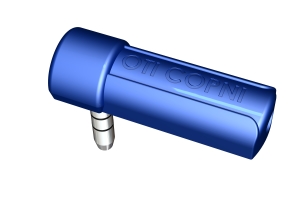
OTI COPNI wave - mobile NFC plug-in module
OTI has demonstrated impressive out-of-the box thinking with this NFC plug-in module for mobile devices. Basically, if your phone has an audio stereo jack, you can have mobile NFC.
 Now the only questions are: which mobile OSes will OTI support, and will the API be open?
If only a few mobile OSes are supported within the first year (or two), then the API had better be open... A closed API would mean that freelance/community developers won't be able to fill the software gap for this device and some will opt for creating competing - and most likely open-source - solutions. This has already happened with mobile phones. Furthermore, integrated chips containing NFC controller+secure element are becoming readily available, as are NFC software libraries, so the entry threshold to the market is clearly not high.
If only a few mobile OSes are supported within the first year (or two), then the API had better be open... A closed API would mean that freelance/community developers won't be able to fill the software gap for this device and some will opt for creating competing - and most likely open-source - solutions. This has already happened with mobile phones. Furthermore, integrated chips containing NFC controller+secure element are becoming readily available, as are NFC software libraries, so the entry threshold to the market is clearly not high.
Monday, 8 September 2008
Of JavaCard 3.0 and things to come
Heuze's blog on smart card tech (especially development and standardisation) has a post discussing JavaCard 3.0. Among other things, he suggests that multithreading in smart cards might be useful, but I'm not sure that multithreading is a desirable (if even workable) feature for a smart card OS. Smart cards are currently only required to cheaply and securely store data, and this functionality determines the on-card resources and application environment. If new technology came out which allowed very inexpensive extension of card resources (e.g. 20+ MHz CPU, 500+ KB RAM) then a whole range of new options would appear.
A killer app would be where the smart card serves as the consumer's PC-in-a-wallet, carrying all their personal details, their cryptographic identification data (logon and authentication) as well as personal preferences and settings for configuring client services (web sites, etc). This data would be accessable via a standardised framework, independent of the system or service used by the client. Of course, this raises the spectre of standardisation again...
Extending this idea to m-commerce follows naturally: secure, transparent, over-the-air/contactless access to your securely stored personal data in your mobile device is something that would be attractive to consumers.
Wednesday, 14 May 2008
Linux talks
Videos from the Embedded Linux Conference, Mountain View, USA, Apr. 2008 are now available. There is a vast array of topics, including "Every Microamp is Sacred - A Dynamic Voltage and Current Control Interface for the Linux Kernel", "Using a JTAG for Linux Driver Debugging", and "UME - Ubuntu Mobile and Embedded". Site seems to be slashdotted for now, but hopefully it'll get back to its feet soon.
Subscribe to:
Posts (Atom)
